Does my participant need Occupational Therapy?
A guide for NDIS Support Coordinators on knowing where to refer, and when occupational therapy is the missing piece.

You know this participant. They see their physio every week, they do their home exercises, and their therapist says they're progressing. On paper, everything is on track.
But when you check in, the picture is different. They still can't manage getting dressed without help. Support workers are cooking most of their meals. They're wiped out for the rest of the day after a single appointment. The goals in their plan haven't moved.
As a support coordinator, you're the person who has to work out what's missing, often with limited time, a long list of providers and a participant who just wants life to feel less hard.
This post is about one of the most common gaps we see: a participant is getting good therapy, but not the right type of support for what matters most to them.
Getting stronger is not the same as getting more independent

Take a participant who has had a stroke. Their physiotherapist has done great work. They're walking independently around the house, their balance is better and their strength is up.
But they still can't make a meal. They forget appointments. They run out of energy by lunchtime. They haven't gone back to the things they used to enjoy.
Their body has improved, but their everyday life hasn't caught up. That's because being physically able to do something isn't the same as being able to do it safely, consistently and on their own in real life. Everyday tasks draw on planning, memory, sensory processing, energy, emotional regulation and the environment around the person, as well as strength and movement.
That's the gap occupational therapy is designed to close.
Physio, exercise physiology and Occupational Therapist: who does what?
When a participant is struggling to achieve their goals, knowing which allied health professional to involve isn't always straightforward.
Physiotherapists, exercise physiologists and occupational therapists all help people improve their function and quality of life. Their roles can overlap, particularly in neurological rehabilitation.
However, they often approach the same problem from different perspectives.
Physiotherapy: Improving movement and physical function
Physiotherapists assess and treat movement-related difficulties, including mobility, balance, strength, coordination and pain.
For example, a physiotherapist might help someone recovering from a stroke improve their walking ability and balance.
Exercise Physiology: Building physical capacity through exercise
Accredited exercise physiologists develop individualised exercise programs to improve physical conditioning, strength, endurance and health.
For example, an exercise physiologist might help someone with multiple sclerosis build their exercise tolerance and maintain physical capacity.
Occupational Therapy: Turning abilities into everyday independence
Occupational therapists look at how a person's physical, cognitive, sensory and environmental challenges affect their ability to perform meaningful daily activities.
For example, someone recovering from a stroke may be walking independently but still unable to prepare a meal because of difficulties with planning, fatigue, upper limb coordination or managing multiple tasks.
An OT assesses these functional barriers and develops strategies to help the person participate more independently in everyday life.
The goal isn't to choose one profession over another. It's to recognise when a participant's functional needs aren't being fully addressed by their current supports.
Five signs it's time to consider OT

1. Physical gains aren't showing up at home. They're training longer and harder in sessions, but mornings, meals and getting out of the house are still a struggle.
2. They can do it once, but not reliably. Someone with multiple sclerosis may be able to shower and dress independently, but have nothing left to make breakfast. Someone with persistent pain or functional neurological disorder (FND) may have capacity that changes from day to day. An OT can look at patterns, pacing and task demands to make routines sustainable.
3. Reliance on support is growing. Support workers are essential. But if a participant's goal is more independence and their support is increasing, it's worth asking whether equipment, task changes, cognitive strategies or graded skill-building could shift things. The aim isn't to remove support. It's to make sure support is doing the right job.
4. The barriers aren't physical. Memory, planning, concentration, sensory overload and cognitive fatigue can be invisible in a physio session but have a huge impact at home or work. These are common after acquired brain injury, stroke, FND, MS and other neurological conditions.
5. Their goals aren't moving despite regular therapy. This doesn't mean their current therapy is failing. It may mean the therapy isn't aimed at the actual barrier. For example, a participant whose goal is returning to work may need endurance work, but also fatigue management, cognitive strategies, graded exposure to work demands and a review of the workplace itself.
"Isn't OT just for equipment and FCAs?"
This is a very common misconception, and it's understandable. Many coordinators first meet OTs through Functional Capacity Assessments, assistive technology assessments and reports.
Those are important. But OT is also ongoing, hands-on intervention. It can mean building memory strategies after a brain injury, working on pacing and sensory regulation with someone with FND, or developing upper limb function and independence skills after a spinal cord injury.
A simple way to think about it: an FCA explains what a participant's needs are. Ongoing OT helps address them. Both have a place, and an OT can help you work out which is the right starting point for a particular participant.
What happens when these barriers go unnoticed?
When the real barriers aren't identified, participants can end up relying on support for things they could learn to do themselves. They may disengage from activities because the demands feel overwhelming. Reports may not capture the true functional impact of their disability, and opportunities for capacity-building get missed.
Not every participant needs OT. But when therapy is happening and daily life still isn't improving, it's a good signal that another perspective is worth bringing in.
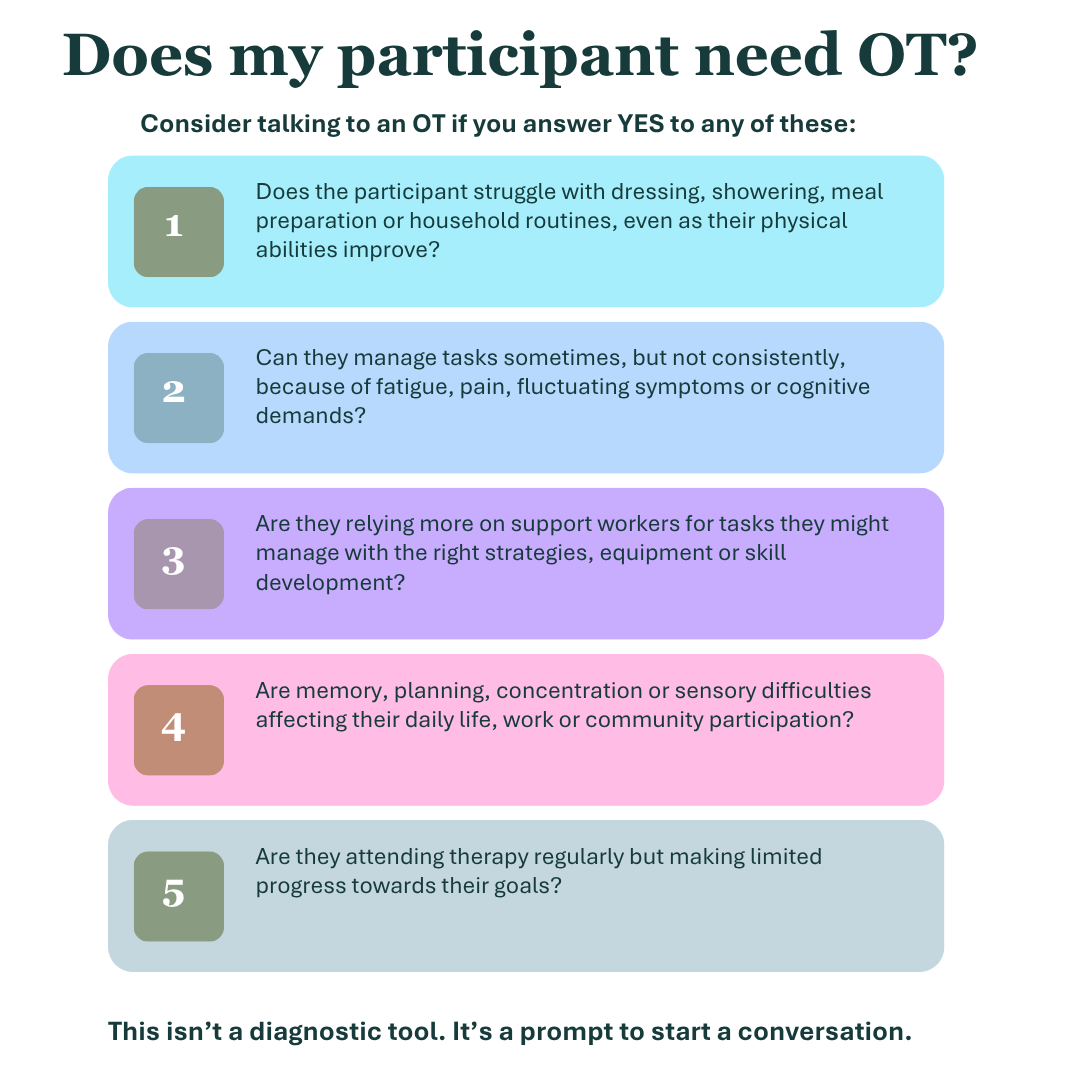
A quick checklist
How One 3 Care can help
One 3 Care is a neurological occupational therapy practice. We work with people living with FND, spinal cord injury, acquired brain injury (including stroke and traumatic brain injury), multiple sclerosis, Parkinson's disease and other neurological conditions, as well as complex fatigue and persistent pain.
Our work includes cognitive, sensory and upper limb rehabilitation, assistive technology and functional capacity assessments, and practical, individualised strategies built around what matters to each person. We see people at our Brisbane clinic and by telehealth where it's clinically appropriate, and we run a structured 14-week FND program.
Not sure whether your participant needs OT? You don't need to have it all figured out. Get in touch with One 3 Care and we'll talk through what's going on and the best next step, whether that's an assessment, ongoing therapy or something else.
One 3 Care | Neurological Occupational Therapy